Not a government app. Bluebell is an independent study app made by Kodfu Bilisim. It does not represent the Home Office, UK Visas and Immigration or any government body, and it is not affiliated with or endorsed by them or by TSO.
Life in the UK practice: Chapter 1, the values and principles of the UK
Free, with no sign-up and nothing saved. These 10 questions are original, written from the facts in the handbook. No app or website can show you the real test questions.
What this chapter covers
Chapter 1 sets out the ideas that British life is built on and what is expected of people who make their home here. It is less about dates than about what each idea means in practice, so these questions ask you to apply the principles as well as name them.
- The fundamental principles: democracy, the rule of law, individual liberty, tolerance of other faiths and beliefs, and taking part in community life.
- The responsibilities of living in the UK, such as obeying the law, respecting other people's rights and treating others fairly.
- The freedoms the UK offers, including freedom of belief and of speech, and the right to a fair trial.
- Citizenship ceremonies: the oath or affirmation, and the pledge.
- Settling in the UK: indefinite leave to remain, citizenship and who has to take the test.
Question 1 · Select TWO answers
Which of these are fundamental principles of British life? Select TWO.
- Following one national religion
- Tolerance of other faiths and beliefs
- Individual liberty
- Loyalty to one political party
Show the answer
Answer B: Tolerance of other faiths and beliefs, C: Individual liberty
Individual liberty and tolerance of different faiths and beliefs are core principles. The UK has no single compulsory party or religion.
Source: Handbook ch. 1 · The values and principles of the UK
Question 2 · Choose one answer
Which phrase best describes the principle of individual liberty?
- Freedom to ignore any laws you personally disagree with
- A right to be given a job by the state
- Freedom to make your own choices within the law
- A duty to follow your family's religion
Show the answer
Answer C: Freedom to make your own choices within the law
Individual liberty means people can choose how to live their lives, as long as they stay within the law.
Source: Handbook ch. 1 · The values and principles of the UK
Question 3 · Select TWO answers
Which of these are responsibilities that people living in the UK should accept? Select TWO.
- Treating others with fairness
- Agreeing with every government policy
- Looking after yourself and your family
- Speaking only English in your home
Show the answer
Answer A: Treating others with fairness, C: Looking after yourself and your family
Treating others fairly and looking after yourself and your family are both expected. You may disagree with the government and use any language at home.
Source: Handbook ch. 1 · The values and principles of the UK
Question 4 · Choose one answer
A neighbour strongly disagrees with your political views. What does British life expect you to do?
- Respect their right to hold their view
- Report them to the police
- Ask the council to warn them
- Insist that they change their view
Show the answer
Answer A: Respect their right to hold their view
Everyone has the right to their own opinion, and respecting that right is one of the responsibilities of living in the UK.
Source: Handbook ch. 1 · The values and principles of the UK
Question 5 · Choose one answer
Which right does everyone in the UK have if they are accused of a crime?
- The right to choose their judge
- The right to a fair trial
- The right to be tried in their country of birth
- The right to a trial without a judge
Show the answer
Answer B: The right to a fair trial
A fair trial is one of the freedoms guaranteed to everyone living in the UK.
Source: Handbook ch. 1 · The values and principles of the UK
Question 6 · True or false?
Freedom of speech means you can say anything in the UK, including threats of violence, without breaking the law.
- True
- False
Show the answer
Answer B: False
Free speech is protected, but it works within the law. Threatening violence or stirring up hatred can be a crime.
Source: Handbook ch. 1 · The values and principles of the UK
Question 7 · Choose one answer
At a citizenship ceremony, what is the difference between the oath and the affirmation?
- The affirmation is only for children
- The oath is spoken and the affirmation is sung
- The oath is made to Parliament and the affirmation to the monarch
- The oath mentions God and the affirmation does not
Show the answer
Answer D: The oath mentions God and the affirmation does not
People who wish to swear by God take the oath. Those who prefer a non-religious promise make a solemn affirmation instead.
Source: Handbook ch. 1 · The values and principles of the UK
Question 8 · Select TWO answers
In the citizenship pledge, new citizens promise to do which of these? Select TWO.
- Vote at every election
- Live in the UK for the rest of their lives
- Uphold the UK's democratic values
- Observe its laws faithfully
Show the answer
Answer C: Uphold the UK's democratic values, D: Observe its laws faithfully
The pledge covers respecting rights and freedoms, upholding democratic values, observing the laws and fulfilling the duties of a citizen. Voting is not compulsory.
Source: Handbook ch. 1 · The values and principles of the UK
Question 9 · Choose one answer
What does indefinite leave to remain allow a person to do?
- Live in the UK permanently
- Hold a British passport
- Visit the UK for up to six months
- Vote in every UK election
Show the answer
Answer A: Live in the UK permanently
Indefinite leave to remain, often called settlement, gives permission to live in the UK permanently. Citizenship and a British passport are a separate step.
Source: Handbook ch. 1 · The values and principles of the UK
Question 10 · True or false?
Once you have indefinite leave to remain, you automatically become a British citizen.
- True
- False
Show the answer
Answer B: False
Settlement lets you live in the UK permanently. Becoming a citizen is a separate application, usually made later.
Source: Handbook ch. 1 · The values and principles of the UK
You’ve seen 10 of 43 questions in Chapter 1
The Bluebell app has all 43, each with an explanation. Across the whole Life in the UK there are 942 questions in 17 topics, plus timed 24-question mock tests of 45 minutes.
All 43 are free in the app. Bluebell Pro is £6.99 one-off: every question, every mock test and every study note. No subscription.
Android now; iPhone version not yet available.
Worth remembering
- The rule of law means nobody is above the law, including people in power.
- Free speech has limits: threatening people or stirring up hatred is not protected.
- At a citizenship ceremony you swear an oath, which mentions God, or make an affirmation, which does not. Then you make a pledge to the UK.
- Indefinite leave to remain lets you live here permanently. Becoming a British citizen is a separate application.
Keep going
- Chapter 2: What is the UK?The four countries and what the names mean · 5 questions
- Chapter 3: A long and illustrious historyBritish history, from the Stone Age to modern Britain · 10 questions
- Chapter 4: A modern, thriving societyUK cities, customs, sport, arts and places · 10 questions
- Chapter 5: The UK government, the law and your roleParliament, the law and taking part · 10 questions
- Life in the UK Test guideFormat, booking, what to bring and the day itself

Want more practice? Get the Bluebell app
942 original practice questions across all five chapters of the handbook, plain-English explanations, full mock tests of 24 questions in 45 minutes, spaced review and a mistakes list. It works offline, with no ads and no account.
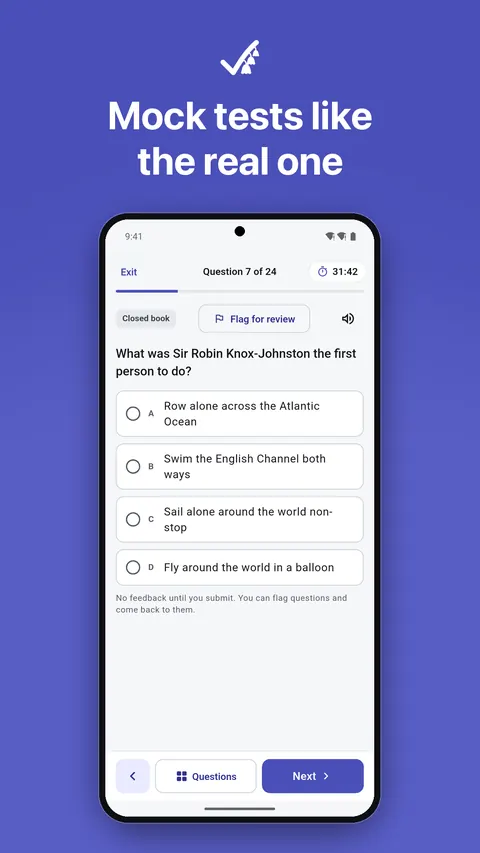
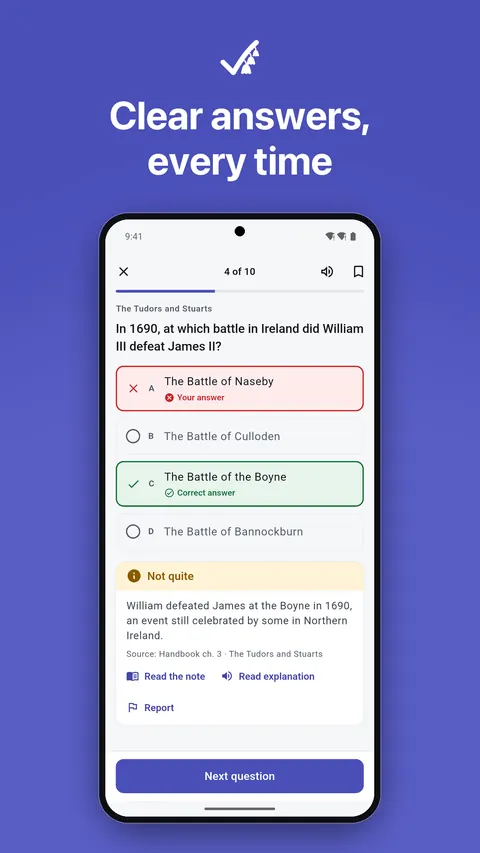
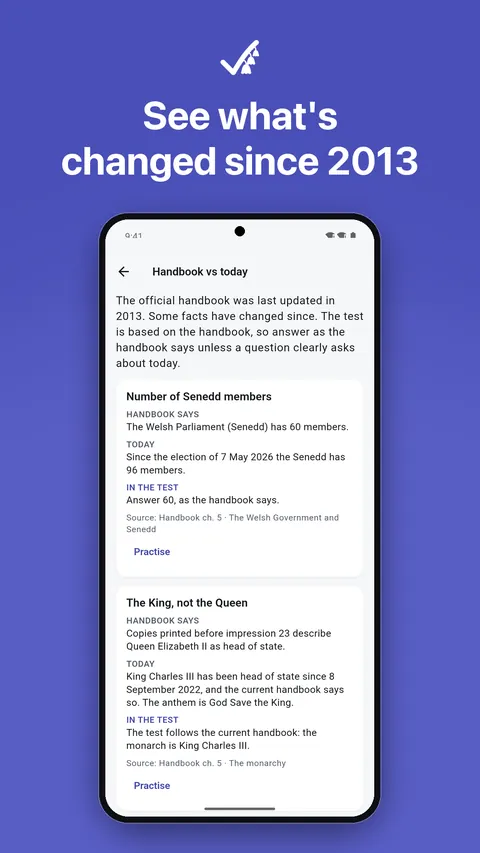
Free: Chapter 1 in full, six free questions in every other topic, two full mock tests and all the tools.
Bluebell Pro, £6.99 one-off: every question, every mock test and every study note. No subscription.
Android now; iPhone version not yet available. Bluebell helps you prepare; it cannot promise a pass.
Official sources
Check these public pages before you book or apply.
- Life in the UK Test (GOV.UK)
- What happens at the test and the pass mark (GOV.UK)
- The handbook and study materials (the shop linked from GOV.UK)
- Book the test (the booking service linked from GOV.UK)
- Settlement, indefinite leave to remain (GOV.UK)
- British citizenship (GOV.UK)
Bluebell's guides are general information, not immigration advice.