Not a government app. Bluebell is an independent study app made by Kodfu Bilisim. It does not represent the Home Office, UK Visas and Immigration or any government body, and it is not affiliated with or endorsed by them or by TSO.
Free Life in the UK practice test: try 10 questions
Free, with no sign-up and nothing saved. The questions are original, written from the facts in the handbook. No app or website can show you the real test questions.
Question 1 · Choose one answer
Which principle means that the government, the police and ordinary people must all obey the same laws?
- Tolerance of other faiths
- Individual liberty
- Community participation
- The rule of law
Show the answer
Answer D: The rule of law
Under the rule of law nobody is above the law, including people in power.
Source: Handbook ch. 1 · The values and principles of the UK
Question 2 · Select TWO answers
Which of these are part of the United Kingdom? Select TWO.
- Wales
- Northern Ireland
- The Republic of Ireland
- The Isle of Man
Show the answer
Answer A: Wales, B: Northern Ireland
Wales and Northern Ireland are two of the UK's four countries. The Isle of Man is a Crown dependency and Ireland is independent.
Source: Handbook ch. 2 · What is the UK?
Question 3 · Choose one answer
In which English county is Stonehenge?
- Wiltshire
- Kent
- Cornwall
- Yorkshire
Show the answer
Answer A: Wiltshire
Stonehenge stands in Wiltshire, in south-west England.
Source: Handbook ch. 3 · Early Britain
Question 4 · Choose one answer
At which battle in 1314 did the Scots defeat the English?
- Bosworth Field
- Bannockburn
- Hastings
- Agincourt
Show the answer
Answer B: Bannockburn
Robert the Bruce led the Scots to victory over the English at Bannockburn in 1314.
Source: Handbook ch. 3 · The Middle Ages
Question 5 · Select TWO answers
Which of Henry VIII's wives were executed? Select TWO.
- Anne Boleyn
- Catherine Parr
- Catherine Howard
- Jane Seymour
Show the answer
Answer A: Anne Boleyn, C: Catherine Howard
Anne Boleyn and her cousin Catherine Howard were both executed. Jane Seymour died after childbirth and Catherine Parr outlived Henry.
Source: Handbook ch. 3 · The Tudors and Stuarts
Question 6 · Choose one answer
Why did George I rely heavily on his ministers?
- He lived in France
- He spoke little English
- He was too young to rule
- He was often ill
Show the answer
Answer B: He spoke little English
George I spoke little English, so his ministers took on more of the work of government.
Source: Handbook ch. 3 · A global power
Question 7 · Choose one answer
Which Minister for Health led the setting up of the NHS?
- William Beveridge
- R A Butler
- Clement Attlee
- Aneurin (Nye) Bevan
Show the answer
Answer D: Aneurin (Nye) Bevan
Aneurin Bevan, Minister for Health, led the creation of the NHS in 1948.
Source: Handbook ch. 3 · Britain since 1945
Question 8 · Choose one answer
Which flower is associated with Wales?
- The rose
- The shamrock
- The daffodil
- The thistle
Show the answer
Answer C: The daffodil
The daffodil is the flower of Wales. The thistle is Scotland's, the rose England's and the shamrock Northern Ireland's.
Source: Handbook ch. 4 · Leisure; Places of interest
Question 9 · Choose one answer
Which statement about British democracy is correct?
- It developed gradually over many years
- It was introduced all at once after a revolution
- It was copied from the French constitution
- It began only after the Second World War
Show the answer
Answer A: It developed gradually over many years
Britain's democracy grew step by step, as the right to vote was gradually widened.
Source: Handbook ch. 5 · British democracy and the government
Question 10 · True or false?
Civil servants are politically neutral and are chosen on merit.
- True
- False
Show the answer
Answer A: True
Civil servants are not political appointees. They are selected on merit and must stay neutral.
Source: Handbook ch. 5 · Devolution; The UK and the world
You’ve seen 10 of 942 questions in the Life in the UK Test
The Bluebell app has all 942, each with an explanation. It also has timed 24-question mock tests of 45 minutes.
139 of them are free in the app, the rest come with Pro. Bluebell Pro is £6.99 one-off: every question, every mock test and every study note. No subscription.
Android now; iPhone version not yet available.
Practise by handbook chapter
Each chapter has its own free quiz, with a short summary of what the chapter covers and different questions from the ones above.
- Chapter 1: The values and principles of the UKBritish values, freedoms, citizenship · 10 questions
- Chapter 2: What is the UK?The four countries and what the names mean · 5 questions
- Chapter 3: A long and illustrious historyBritish history, from the Stone Age to modern Britain · 10 questions
- Chapter 4: A modern, thriving societyUK cities, customs, sport, arts and places · 10 questions
- Chapter 5: The UK government, the law and your roleParliament, the law and taking part · 10 questions
Getting ready for test day?
Read our plain-English guide to the test format, booking, what to bring and what happens on the day, written from GOV.UK.

Want more practice? Get the Bluebell app
942 original practice questions across all five chapters of the handbook, plain-English explanations, full mock tests of 24 questions in 45 minutes, spaced review and a mistakes list. It works offline, with no ads and no account.
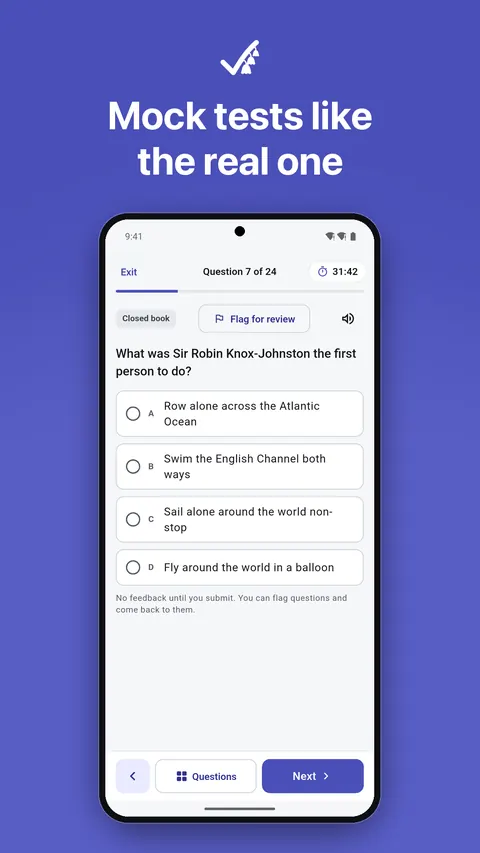
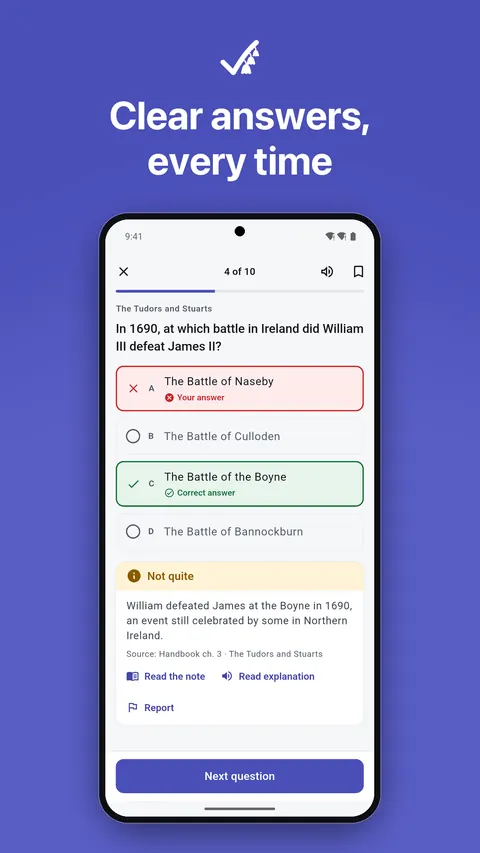
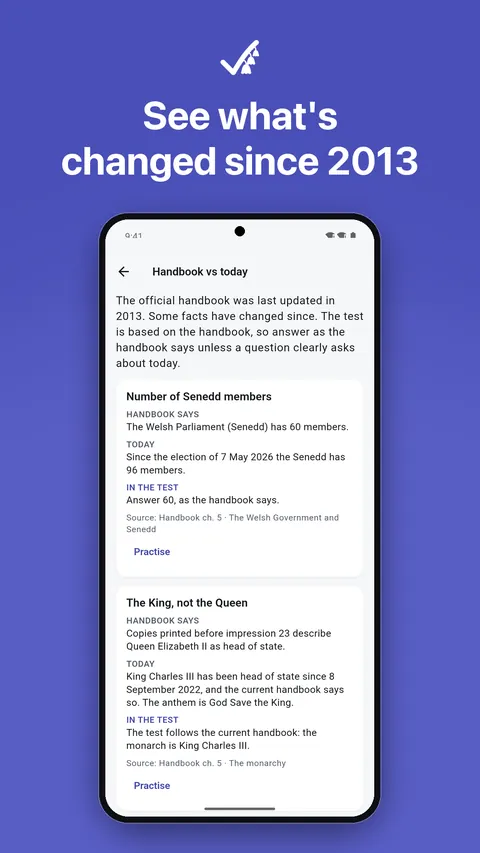
Free: Chapter 1 in full, six free questions in every other topic, two full mock tests and all the tools.
Bluebell Pro, £6.99 one-off: every question, every mock test and every study note. No subscription.
Android now; iPhone version not yet available. Bluebell helps you prepare; it cannot promise a pass.
Official sources
Check these public pages before you book or apply. Bluebell's test facts come from them.
- Life in the UK Test (GOV.UK)
- What happens at the test and the pass mark (GOV.UK)
- Cancellations and refunds (GOV.UK)
- Book the test (the booking service linked from GOV.UK)
- The handbook and study materials (the shop linked from GOV.UK)
- Settlement, indefinite leave to remain (GOV.UK)
- British citizenship (GOV.UK)
- Citizenship requirements and time outside the UK (GOV.UK)
- Continuous residence and absences for settlement (Immigration Rules, GOV.UK)
Bluebell's guides are general information, not immigration advice.